
Multitouch Turing Machine
The Turing Machine sequencer is inspired by the legendary Music Thing Modular Turing Machine, a random looping sequencer that originated in the Eurorack modular synthesizer world. The original hardware module, designed by Tom Whitwell, uses a shift register to create sequences that can range from completely locked and repeating to fully random, with a "controlled chaos" sweet spot in between where patterns slowly evolve over time.
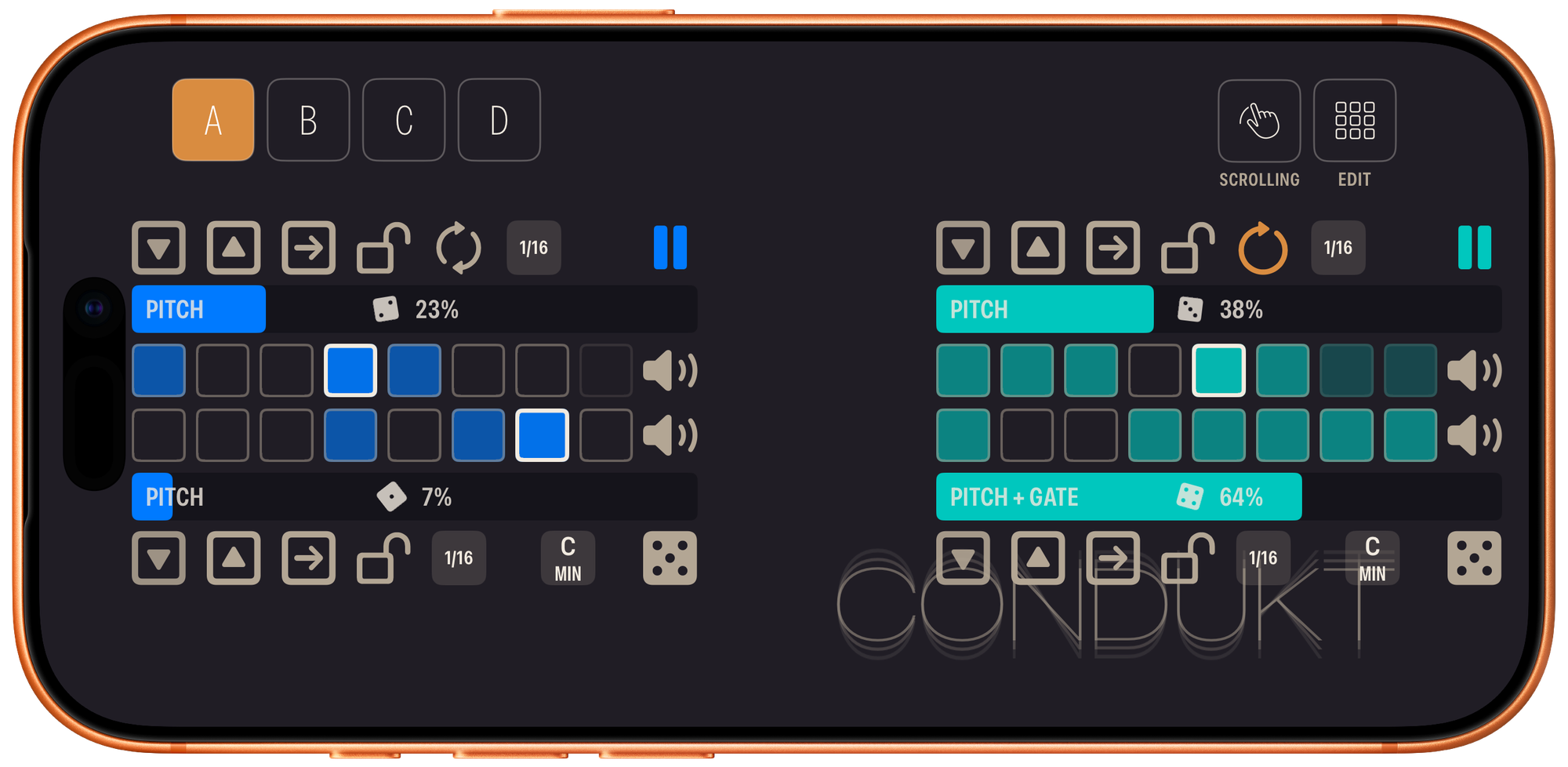
In Condukt, we've adapted this concept for MIDI, giving you two independent lanes that can generate endlessly evolving melodic patterns for your hardware synths.
What Makes It Different
Unlike a traditional step sequencer where you program every note, the Turing Machine generates patterns that mutate over time. The core idea is simple: a sequence loops, but on each pass there's a chance that notes will change. Set the corruption low and your pattern stays locked. Crank it up and chaos ensues. Find the sweet spot in the middle, and your sequences will slowly drift and evolve—familiar enough to groove with, unpredictable enough to keep things interesting.
The Interface
The Turing Machine sequencer features two independent lanes (Seq 1 and Seq 2), each with its own:
- 8-step pattern display showing which steps are active (gates) and the current playhead position
- Corruption slider controlling how much the pattern mutates
- Independent clock division (1/16, 1/8, 1/4T, 1/4)
- Lock, Mute, and Length controls
Controls Explained
Corruption Slider
The horizontal slider at the heart of each lane. Drag it to control mutation:
- 0%: Pattern is completely locked, repeats exactly
- 1-50%: Only pitch values can change (rhythm stays intact)
- 51-100%: Both pitch AND gate triggers can change (rhythm evolves too)
The slider shows "Pitch" or "Pitch + Gate" to indicate which mode you're in, along with a rolling die icon that spins as you increase randomness.
Octave Transpose (↑↓ arrows)
Shift all notes in a lane up or down by one octave. The button brightness indicates where in the MIDI range your notes currently sit.
Pattern Rotate (→ arrow)
Shifts the entire pattern one step to the right, rotating the last step to the beginning. Great for finding new variations on an existing pattern.
Lock (🔒)
When locked, the lane ignores the corruption slider entirely—your pattern stays exactly as is, even at 100% corruption. Useful for locking in a bassline or motif temporarily.
Mute (🔇)
Silences MIDI output for that lane while keeping the pattern running and evolving. The sequence continues to mutate; you just won't hear it until you unmute.
Length (tap steps)
Tap any step in the pattern to set the loop length. Tap step 4 to loop just the first 4 steps; tap step 8 to use the full pattern.
Speed (1/16, 1/8, etc.)
Each lane can run at its own clock division, creating polyrhythmic textures. In Parallel mode, lanes run independently. In Chained mode, both lanes share Seq 1's division.
Mode Toggle (↻)
- Parallel (two arrows): Both lanes play simultaneously at their own speeds
- Chained (single arrow): Seq 1 plays through completely, then Seq 2 plays, then back to Seq 1, like an A/B pattern
Scale & Root
Tap the scale button (showing root note and scale type) to constrain generated notes to a musical scale. All mutations will respect the selected scale, keeping things musical even at high corruption.
Seed (🎲)
Generates a completely new random pattern for both lanes. Hit this when you want a fresh starting point.
Performance Tips
- Start locked, then open up: Begin with corruption at 0%, find a pattern you like with the Seed button, then slowly increase corruption to let it evolve
- Use different lengths: Set Seq 1 to 5 steps and Seq 2 to 7 steps for patterns that phase against each other
- Lock one, free the other: Keep your bass locked while letting the lead line wander
- Chained mode for call-and-response: Use chained mode with different note ranges for melodic dialogue
- Mute for builds: Mute a lane, let it mutate, then unmute for a surprise variation
Syncing with Other Sequencers
The Turing Machine shares Condukt's master clock with the standard Conduktor sequencer. You can run both types simultaneously, perhaps a Conduktor handling bass while a Turing Machine generates evolving melodies, and they'll stay perfectly in sync.